
How Beyond Faith Homecare Helps Texas Families Find the Right Care at Home
When someone you love needs more support at home, one of the hardest parts can be knowing where to begin.
Does your family need a nurse or therapist after a hospitalization? Would help with personal care and everyday routines make it safer for someone to remain at home? What if those needs change over time?
At Beyond Faith Homecare, we have helped Texas families navigate questions like these since 2003. Our role is not simply to provide care. It is to help patients and families better understand the type of support that may fit their situation and connect them with the appropriate local resources.
You can learn more about our story of serving Texas communities since 2003.
This guide explains some of the most common types of care available at home, when families may consider them, and how to find the Beyond Faith team serving your community.
How Do You Know What Kind of Care at Home Is Right?
“Care at home” can mean several different things.
Two families may both say they need help at home while actually needing very different services. One person may be recovering from surgery and require a nurse or physical therapist. Another may be medically stable but need assistance bathing, dressing, preparing meals, or safely moving around the home.
Understanding that distinction is an important first step.
Medicare-certified home health care focuses on skilled medical and rehabilitation needs. Care is generally provided according to a physician-directed plan and may involve nurses, therapists, home health aides, and other healthcare professionals based on the patient’s needs.
In-home senior care focuses more on everyday support. Depending on the individual’s needs and the services available in the community, that may include personal care, companionship, assistance with activities of daily living, and other help that supports safety and independence at home.
Families who want a deeper comparison can also read our guide to the difference between home care and home health.
Neither type of care is universally “better.” The right choice depends on the person’s health, functional needs, goals, and circumstances.
When Might Home Health Care Be Appropriate?
Home health often becomes part of the conversation after a change in someone’s health.
A person may be returning home after surgery or hospitalization, recovering from an illness or injury, adjusting to a new diagnosis, or experiencing changes in strength, balance, mobility, or the ability to manage a medical condition.
Depending on eligibility and the plan of care, home health services may include skilled nursing care at home along with physical, occupational, or speech therapy and other appropriate services.
One of the advantages of home health is that treatment takes place where everyday life actually happens.
A therapist can see the stairs a patient needs to navigate. A nurse can better understand how medications and health routines fit into the person’s day. Family members and caregivers can often participate in education and planning within the same environment where care will continue between visits.
If home health is unfamiliar to your family, our guide to how home health care works in Texas provides a more detailed explanation of eligibility, services, and what families can expect.
When Might In-Home Care Be the Better Fit?
Not every person who needs help at home requires skilled medical care.
Sometimes the concern is more practical.
A loved one may have difficulty bathing safely, preparing meals, getting dressed, moving around the house, or keeping up with normal routines. Family caregivers may also need additional help so that supporting someone at home remains manageable over the long term.
In these situations, private duty in-home care can provide non-medical support centered on daily living and independence.
For some families, home health and in-home care may even be used at the same time for different purposes. A person might receive intermittent skilled nursing or therapy visits while also receiving additional assistance with everyday activities.
The important question is not simply, “Do we need care?”
It is, “What kind of help does this person need to remain as safe, healthy, and independent as possible at home?”
What If a Person’s Care Needs Change?
Home-based care is rarely one-size-fits-all forever.
Someone recovering from a hospitalization may become stronger and no longer need skilled home health services. Another person may begin needing more assistance with everyday activities. A serious illness may eventually lead a patient and family to begin discussing comfort-focused care or hospice.
Those changes can be difficult, but understanding the different levels of care can make them less confusing.
Home health and hospice, for example, serve different clinical purposes and are appropriate at different points in a person’s care journey. We’ve explained that relationship in greater detail in our article about how home health and hospice work together in Texas care plans.
Beyond Faith Homecare provides home health and in-home care, but does not operate as a hospice provider. For families exploring hospice care in Texas, St. Gabriel’s Hospice & Palliative Care is an option within the same LifeCare Home Health & Hospice Family. The two teams work closely together as care needs change.
When care needs change, it can help to have providers who know one another and can communicate across different stages of care. Being part of the same family of companies gives Beyond Faith Homecare and St. Gabriel’s an opportunity to work together while helping patients and families understand their options and choose the care that’s right for them.
What Should Families Look for in a Home-Based Care Provider?
Choosing a provider involves more than comparing names in a search result.
Families should understand what kind of care an organization actually provides, whether it serves their location, and whether the services being discussed match the person’s needs.
For skilled home health care, Medicare certification and appropriate clinical oversight matter. Families may also want to understand how the provider communicates with physicians and caregivers, which disciplines are available, and how the organization approaches patient safety and care coordination.
Local presence matters too.
Healthcare happens through relationships. A home health agency that works regularly with local physicians, hospitals, rehabilitation facilities, and other healthcare professionals may be better positioned to coordinate care within the community.
Families can also look at patient experience and independent recognition as additional pieces of information.
In 2025, Beyond Faith Homecare locations in Wichita Falls, Graham, and Weatherford earned SHPBest Home Health Patient Experience recognition. Wichita Falls received Top 5% Premier Performer recognition, while Graham and Weatherford were recognized as Top 20% Superior Performers.
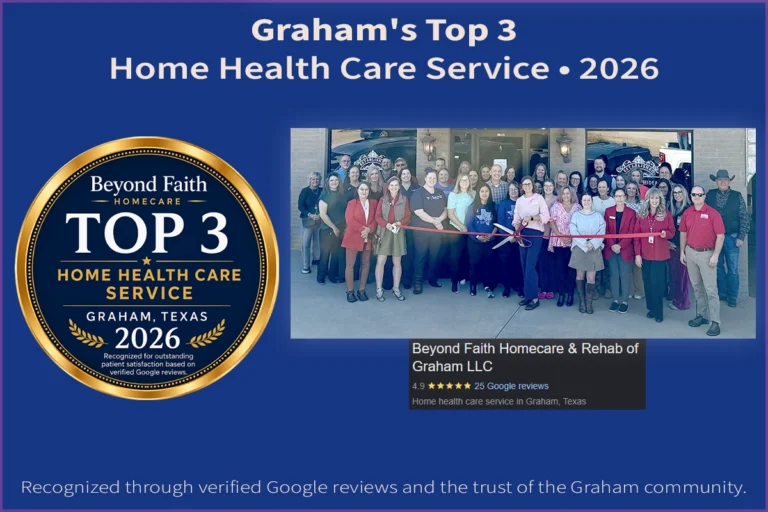
Our Graham team has also been recognized among Graham’s Top 3 Home Health Care Services.
Awards do not replace an individual family’s experience, which is why we also encourage people considering care to read experiences shared by patients and families.
What Guides the Way Beyond Faith Homecare Approaches Care?
Since 2003, Beyond Faith Homecare has grown across Texas, but the work still happens one patient, one family, and one home at a time.
Our approach is guided by five I-CARE values:
Integrity. Compassion. Accountability. Respect. Excellence.
Those principles matter particularly in home-based care because being invited into someone’s home carries a unique responsibility.
Clinical knowledge matters. Reliability matters. Communication matters.
So does recognizing that behind every referral, diagnosis, therapy goal, or plan of care is a person trying to continue living his or her life.
That human element is one reason we believe local teams remain so important, even as Beyond Faith benefits from the resources and support of a larger healthcare family.
Looking for Beyond Faith Homecare in Texas?
Healthcare organizations can sometimes have similar names, which can make researching care online confusing.
If you’re looking specifically for Beyond Faith Homecare, our Texas organization has served communities since 2003 and provides Medicare-certified home health care along with in-home care in select markets.
Our home health locations serve:
San Antonio, New Braunfels, Irving, Lubbock, Wichita Falls, Weatherford, Graham, and Sugar Land.
Our in-home senior care and personal care services are available in:
San Antonio and New Braunfels.
When researching any healthcare provider, it is worth confirming three things: the organization you are contacting, the services it provides, and whether the local office serves your community.
A company name is only the beginning. The more important question is whether the organization offers the right care for the person who needs it.
How Do I Find the Beyond Faith Team That Serves My Community?
Care at home is local by nature. The team needs to understand the community, serve the patient’s location, and be able to coordinate with the physicians, hospitals, rehabilitation facilities, and other healthcare resources involved in that person’s care.
Beyond Faith Homecare has home health teams serving communities across Texas.
San Antonio
Families in San Antonio, Texas can connect with the local Beyond Faith team to learn more about home health services and available in-home care options in the area.
New Braunfels
Our New Braunfels, Texas team serves New Braunfels and surrounding Central Texas communities, with both home health and in-home care resources available based on individual needs and service area.
Irving
The Irving, Texas location supports patients and referral partners throughout the Dallas-Fort Worth area with Medicare-certified home health care.
Lubbock
Our Lubbock, Texas team provides home health services in Lubbock and surrounding West Texas communities.
Wichita Falls
Families in Wichita Falls, Texas can connect with a local Beyond Faith home health team that has also earned recognition for patient experience.
Weatherford
Our Weatherford, Texas team serves patients and families in Weatherford, Parker County, and surrounding communities.
Graham
The Graham, Texas team provides Medicare-certified home health services while maintaining strong ties to the local community.
Sugar Land
Our Sugar Land, Texas office serves patients throughout Sugar Land, Fort Bend County, and the Greater Houston area.
Because service availability can vary by location and individual need, contacting the appropriate local team is the best way to confirm whether a particular service is available in your community.
What Happens When You Contact Beyond Faith Homecare?
You do not need to understand every healthcare term or know exactly which service to request before reaching out.
The first step is usually a conversation.
Families can explain what is happening, where the patient lives, what changes or challenges they are seeing, and whether a physician, hospital, rehabilitation facility, or other healthcare professional has recommended care at home.
From there, the appropriate team can help determine whether Beyond Faith provides the type of care being considered, whether the location falls within the service area, and what additional information may be needed.
For home health, that process may include coordination with the patient’s physician and review of clinical needs and eligibility requirements.
For in-home care, the conversation may focus more heavily on the type and amount of day-to-day assistance the person requires.
The goal is to identify an appropriate next step rather than expecting families to diagnose the solution themselves.
Frequently Asked Questions About Finding Care at Home in Texas
How do I know whether my loved one needs home health or in-home care?
Home health generally addresses skilled medical or rehabilitation needs and may involve nursing or therapy under a physician-directed plan of care. In-home care generally focuses on non-medical assistance with everyday activities such as personal care, mobility, companionship, and routine support. Some individuals may benefit from both types of care for different reasons.
Does Medicare cover home health care?
Medicare may cover qualifying home health services when eligibility requirements are met. Coverage depends on factors including the patient’s clinical needs and plan of care. Families should discuss their circumstances with the home health provider and appropriate healthcare professionals rather than assuming that every type of care provided in the home is covered by Medicare.
Can home health help after a hospital stay?
Yes. Home health is often used when an eligible patient continues to need skilled nursing, rehabilitation, or other qualifying services after returning home from a hospitalization, surgery, illness, or injury.
Can someone receive home health and in-home care at the same time?
In some situations, yes. The services address different needs. A patient might receive skilled home health visits while also receiving non-medical assistance with everyday activities. The appropriate arrangement depends on the individual’s needs, eligibility, and available services.
Does Beyond Faith Homecare provide hospice?
Beyond Faith Homecare specializes in home health and in-home care rather than hospice services. When hospice becomes appropriate, families can speak with their healthcare providers and care team about eligibility, goals of care, and next steps. Beyond Faith works closely with St. Gabriel’s Hospice & Palliative Care, a fellow member of the LifeCare Home Health & Hospice Family that provides hospice and palliative care across Texas.
How do I find the Beyond Faith Homecare location closest to me?
Beyond Faith Homecare has Texas home health teams serving San Antonio, New Braunfels, Irving, Lubbock, Wichita Falls, Weatherford, Graham, and Sugar Land. The appropriate local office can confirm its service area and the services currently available in your community.
Not Sure Where to Start? Start With a Conversation.
Families do not need to have the entire care plan figured out before asking for help.
If someone you love is returning home from the hospital, struggling with everyday activities, experiencing changes in health or independence, or simply needs more support than the family can provide alone, the next step may be as simple as asking questions.
Our Texas teams can help you better understand the services available through Beyond Faith Homecare and connect you with the appropriate local resources.
About the Author

Renan Augusto
Marketing Manager, LifeCare Home Health & Hospice Family
Blending digital innovation, compassion, and strategy to elevate home health, in-home care, and hospice across the LifeCare Home Health & Hospice Family.
Renan Augusto is a digital marketing strategist with a Master of Science in Digital Marketing, Meta Digital Marketing Certification, and specialized training in AI-powered marketing through Semrush. He brings a strategic, people-first approach to the LifeCare Home Health & Hospice Family, helping families across the country to find trusted, compassionate in-home care through clear and meaningful communication.
With extensive experience in the senior care space, Renan has helped hundreds of families begin home care services. As a Certified Dementia Practitioner, he brings empathy and clarity to every project, ensuring that education and outreach remain accessible, respectful, and centered on real people.
Renan previously served as Marketing Chair for GROWS and continues to serve as an Advisor. GROWS is a nonprofit organization focused on strengthening the senior care community through advocacy, education, and collaboration. His work centers on connection, authenticity, and digital strategies that make a meaningful difference in people’s lives.